


We’ve raised many concerns about the state of democracy in this newsletter, but did voters even care about that?
Let’s take a look at what the exit polls say. Keep in mind, early exit polls tend to be less accurate than polling results that come later, so think of this as a preliminary analysis.
The main concern on voters’ minds was the economy, and that showed in many different polling questions about tariffs, gas prices, inflation, and cost of living. When asked about the most important issues facing the country, a plurality (39%) said the economy, and those voters preferred Democrats 52% to 46% in the national exit poll. “The state of democracy” was, however, a close second at 33% and those respondents favored Democrats in key House races by a whopping 79% to 20%.
Democracy was even the top issue in four key Senate races. In Maine most especially, 39% of voters said democracy was their top concern, compared to 29% for the economy. The Democrat, Troy Jackson, defeated Republican incumbent Susan Collins in that race and democracy voters preferred Jackson 80% to 20%. In Alaska, democracy was the top concern of 36% of voters (28% said the economy) and democracy voters preferred Democrat Mary Peltola to Republican Dan Sullivan 73% to 23%. In Kansas, a slight plurality said democracy was the top issue (34%) while the economy came in a close second (33%), and democracy voters preferred Democrat Adam Hamilton over Republican Roger Marshall 71% to 27%. In Iowa as well, democracy was the top issue by a mere percentage point (33%, versus 32% for the economy) and the democracy voters favored Democrat Josh Turek over Republican Ashley Hinson (73% to 26%).
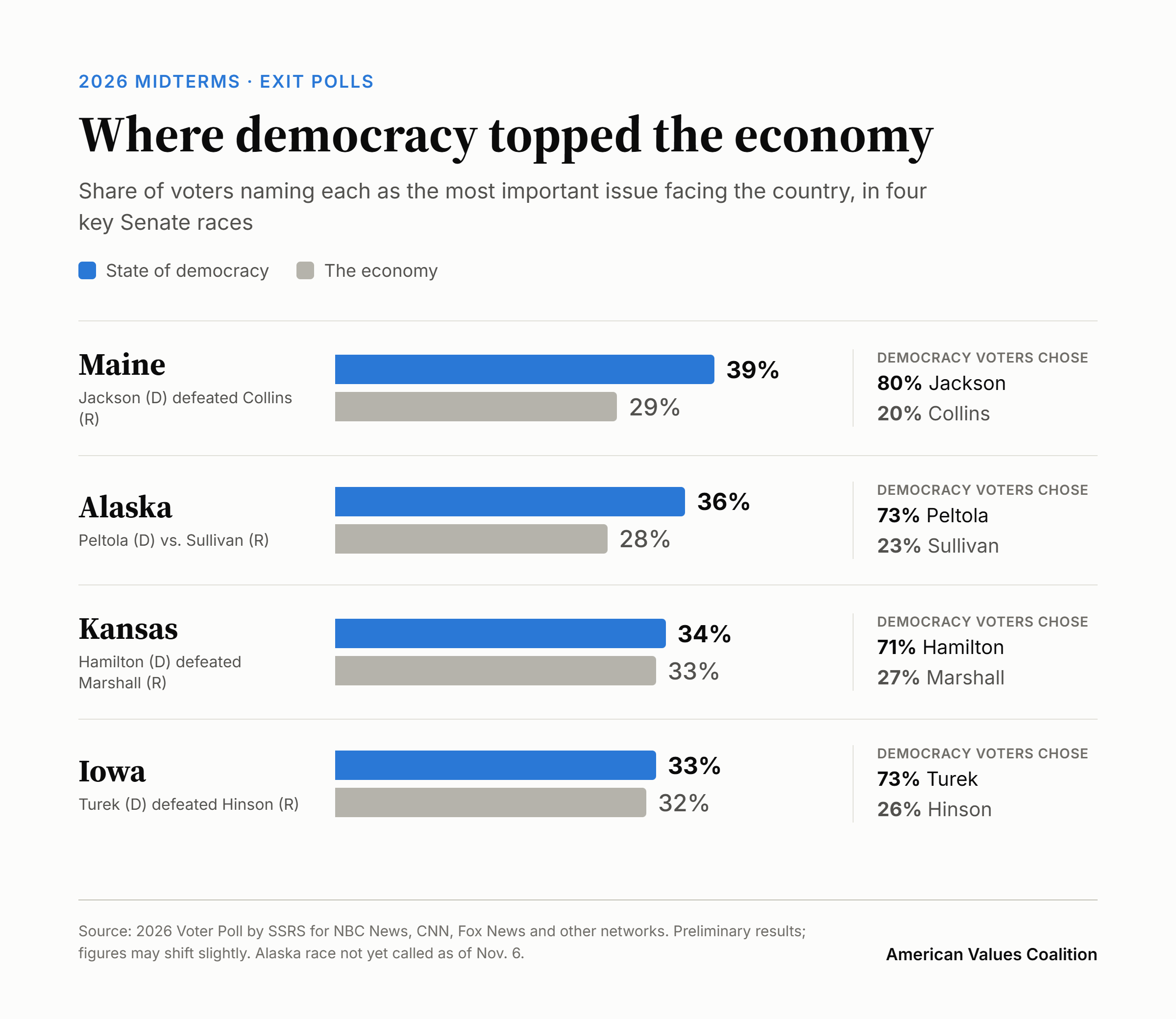
These early results suggest that democracy was a key concern for roughly one-third of the electorate, and that concern was a reason Republicans suffered big losses.
American Values Coalition’s tagline is “Evangelicals for truth, civility, and democracy.” I’ll be looking at future studies to see how all three of those values played in this election. In many of these races, we saw Republican candidates use misinformation and model incivility while defending an authoritarian-minded Republican president. Was this election a backlash against all of that? I want to be clear-eyed in what I’m suggesting. I do believe that Republicans would have done much better with a strong economy, but I’m hopeful that these values were important for at least a portion of the electorate.
What We’re Reading
Walter Olson: “It Was Failed Election Meddling, Not Absence of Election Meddling”
President Trump, who often campaigned on the slogan “too big to rig,” has told reporters he will accept rather than try to overturn the midterm election results. That would be welcome. If so, he might want to offer a token of seriousness by asking the Department of Justice to drop the meritless litigation it is still pursuing, seeking to overrule the state of Alaska’s authority to certify a winner in its Senate race.
The Editorial Board of the Wall Street Journal is already suggesting that there was no need for “all the hyperventilating about what Mr. Trump might do” to meddle with the midterms—after all, they went forward without incident. The “wildly speculative nightmares about mass election theft,” it avers, were “another partisan panic attack, promoted to gin up interest and enthusiasm”—that is, were promoted insincerely.
The editorial’s chosen narrative requires a great forgetfulness about the actual record. It is clear that for the past 18 months, Trump has indeed been intent on messing with the midterms.
The Dispatch: “The Fight for the Right Starts Now”
There are scores of current Republican lawmakers who have long believed the party needed new direction, even if they’ve often been afraid to say so in public. We know this because they tell us in hushed, off-the-record conversations—conversations that have been taking place since Trump first arrived on the political scene more than a decade ago. We hope the results of these midterms will embolden them to say in public what they’ve told us in private over the years.
The beginning of the end of the Trump era is now here. As we wrote in an editorial earlier this year, what America needs is a return to the principles the Founders enshrined in the constitutional order Trump and his allies have sought to undermine—the principles the conservative movement used to champion.
We’ve pointed out many times before that America no longer has a limited government party. It needs one.
Tish Harrison Warren: “I’m Glad Talarico Won. I Just Wish He Was Weirder.”
Throughout their campaigns, I found myself in the odd position, as a Christian and a pastor, of wishing both Paxton and Talarico would talk less about Jesus. It’s not that I think politicians need to keep their beliefs quiet. It’s that both Paxton and Talarico’s versions of faith seem to fit so tidily into their political parties’ priorities. Talarico, very famously, stumbled through a specious theological argument about how God is for abortion rights because he asked for Mary’s consent before Jesus’s miraculous conception. He has quoted the apocryphal Gospel of Thomas in sermons. He seems at times contemptuous of traditional Christian sexual ethics. He referred to women as “neighbors with a uterus.” In short, he’s a pretty typical progressive, mainline seminary student. This doesn’t mean I think he shouldn’t have a voice (or a senate seat, for that matter), but it also does not represent anything all that unique or countercultural. It’s predictable. Same old.
Already, media outlets are hailing Talarico’s victory as a new rise of the religious left. But simply replacing a partisan and politically captive religious right with an equally partisan and politically captive religious left is still harmful for the church and for her public witness.
I have long resented how conservatives—when I was a kid it was the Moral Majority, and now it is parts of the MAGA movement—strip Jesus of his prophetic strangeness and dirty feet to dress him up as a white Republican in a suit and a red tie, who quite conveniently affirms everything that’s already in their party’s platform. It is no great victory if the religious left takes the same old political Jesus in the suit and simply turns his tie blue.
Different party. Same idolatry.