


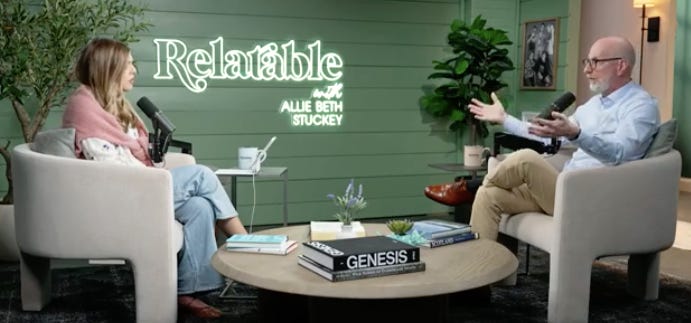
For those familiar with “Christian Twitter”, you’ve already seen much of the chatter this past week surrounding Relatable podcast host Allie-Beth Stuckey’s most recent recording with guest, author and political commentator, David French. And for fellow “way too online” folks, you’re also familiar with the shared tension the two share regarding their interpretations of the American Constitution and the Christian’s role in civic engagement.
The two sat down for a rare hour and a half conversation, where they aired out their differences in a…dare we say…good faith discussion? The two have shared a history of online bickering, but they kept this discussion respectful and centered around meaningful content instead of “hot takes”. Seated across from each other, there was little room to be petty and a mountain of topics to discuss.
American Values Coalition had our own run-in with Stuckey last year after fellow online personality, Meghan Basham, targeted one of our projects, the j29 Coalition, accusing us of being a front group for leftist ideologues. Stuckey went on the Charlie Kirk Show to echo Basham’s talking points.

Our Director, Napp Nazworth, responded to these accusations in a The Dispatch (Faith) piece, reminding fellow Christians not to place politics over theology—it is not only sinful, but also misrepresents the actual mission of Christ. Jesus didn’t come to overthrow the government of His time. He came to create a future Kingdom that could never be shaken. Christians must learn to engage in the temporary kingdoms of our time with grace and truth. One way to do this is through having collective, good faith conversations around how to solve the cultural and political problems of our time.
And in order for the American experiment to succeed, we must be able to let rigorous, winsome debate win hearts and minds. This style of engagement used to be essential to the success or “reach” of any serious public figure—a benchmark one had to cross in order to earn the approval of the general public. Sadly, in the Trump social media era, civil discourse has eroded.
But this past week, something shifted.
Both French and Stuckey were able to articulate their separate opinions without reaching for the lowest hanging fruit. While we may not agree with many of Stuckey’s takes, we certainly give her credit for hosting French. And while most of her promotional social media posts centered around “gotcha” moments, French respectfully shared a “Thanks for hosting me, Allie Beth!” post…but ya know what? Let’s not digress. We’ll take the progress!
What We’re Reading
NBC News: “In rare interviews, Bush hails the First Amendment and Obama says America doesn’t have ‘kings’”
Ahead of America’s 250th anniversary this summer, former Presidents Joe Biden, Barack Obama, George W. Bush and Bill Clinton each shared a message about what they value about the country and how it can emerge from a difficult era.
The Free Press: “They Were Ordered Back to Haiti. Then Their Conservative Church Stepped In.”
A deportation order became a test of faith for one rural Texas church. Its members chose to put their neighbors before politics.
VoteBeat: “New voting requirements? Troops at the polls? We asked 37 election experts what could disrupt the 2026 elections.”
37 experts in the field of election administration were surveyed with 26 questions about the upcoming 2026 midterms.
Their answers reflect a general sense of cautious optimism about the most dire scenarios — such as an election getting overturned — and skepticism that the federal government will successfully change voting rules. But they also still believe the election will face serious challenges, including federal agents potentially showing up at polling places.
Miami Herald: “Amid quarrel with pope, Trump strips Miami charity of funding to house migrant kids
The Trump administration has abruptly canceled an $11 million contract with Catholic Charities to shelter and care for migrant children who enter the U.S. alone, ending a relationship between the Catholic Church and the U.S. government dating back to the first arrivals of Cuban exiles in South Florida.