


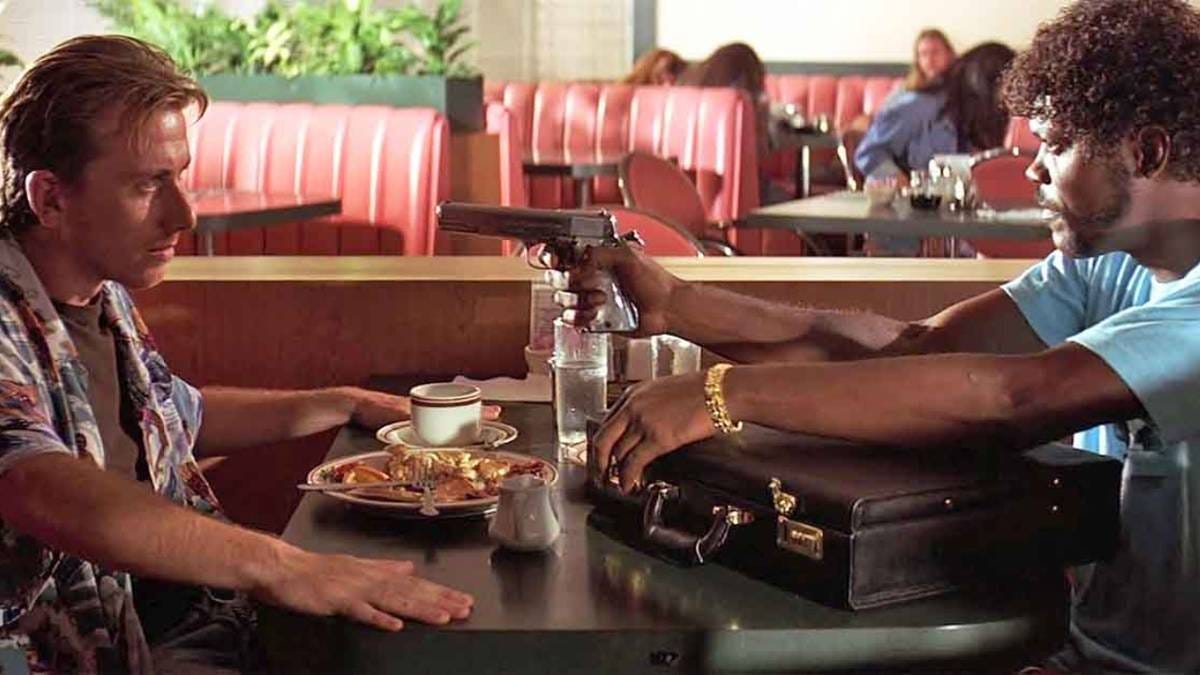
In 1976, an English-dubbed version of the 1973 Japanese martial arts film “Bodyguard Kiba” was released in American theaters. The film begins with a Bible verse, but not a real Bible verse. Roughly based upon Ezekiel 25:17, the fake verse reflects the theme of the film (but not the Bible): a lone hero getting vengeance on his enemies.
A 13-year-old boy in California was a huge fan of martial arts films at the time. That boy really liked the fake Bible verse and when he grew up to become a director, put the fake verse in his own film. So a modified version of the fake verse was made famous in Quentin Tarantino’s “Pulp Fiction” (1994).
This week, yet another rewrite of the verse was made famous by Secretary of Defense Pete Hegseth. At a Wednesday prayer service at the Pentagon, Hegseth prayed a prayer, which he called “CSAR 25:17,” that he said was recited by Sandy 1, the rescue mission that successfully retrieved a downed pilot in Iran. (CSAR stands for Combat Search and Rescue.) The prayer was a modified version of Tarantino’s fake verse.
Many of our Christian political leaders don’t look to the actual Bible, but a Bible twisted over and over again to fit their own agendas. The current squabble between the Administration and the Vatican also illustrates this well.
Pope Leo XIV said President Donald Trump’s rhetoric was “truly unacceptable” after Trump threatened Iran with war crimes, posting, “an entire civilization will die tonight.” Leo also described the war with Iran as, “a war which many people have said is an unjust war, which is continuing to escalate, and which is not resolving anything.”
In a lengthy Sunday night post, Trump responded that “Pope Leo is WEAK on Crime, and terrible for Foreign Policy,” and falsely claimed that the Catholic Church was arresting people for holding church services during COVID.
Vice President J.D. Vance weighed in as well. “If you’re going to opine on matters of theology, you’ve got to be careful; you’ve got to make sure it’s anchored in the truth,” Vance said about Pope Leo at a Tuesday TPUSA event.
Vance also brought up Just War Theory, a Catholic ethical framework for determining when the use of force is justified, which has been influential in international law.
Together, these stories illustrate how Christian Trump administration leaders appeal to Just War Theory, the Bible, and Tarantino while misrepresenting all three.
1. Just War Theory
Our war with Iran does not fulfill the requirements of Just War Theory. For instance, war must be only used as a last resort. This conflict has been going on for 47 years and there was no imminent danger that required attacking Iran now. Also, war must be carried out by a legitimate authority. Under our Constitution, only Congress has the authority to declare war. Congress wasn’t even informed. And most importantly, civilians and non-combatants must not be targeted, so Trump is threatening a violation of Just War when he posts, “an entire civilization will die.”
2. The Bible
Hegseth’s prayer praises vengeance and gloats over defeat of enemies. “And I will strike down upon thee with great vengeance and furious anger those who attempt to capture and destroy my brother, and you will know my call sign is Sandy 1 when I lay my vengeance upon thee,” Hegseth prayed.
But in the original verse from Ezekiel, seeking vengeance and gloating over enemies is exactly what God condemns. Writing to exiles in Babylon, the prophet Ezekiel writes about God’s judgement on the enemies of Israel because they gloated, “you have clapped your hands and stamped your feet, rejoicing with all the malice of your heart against the land of Israel” (vs. 6) and “took revenge on Judah and became very guilty by doing so” (vs. 12).
Note the full context of verse 17, which begins with verse 15,
“This is what the Sovereign Lord says: ‘Because the Philistines acted in vengeance and took revenge with malice in their hearts, and with ancient hostility sought to destroy Judah, therefore this is what the Sovereign Lord says: I am about to stretch out my hand against the Philistines, and I will wipe out the Kerethites and destroy those remaining along the coast. I will carry out great vengeance on them and punish them in my wrath. Then they will know that I am the Lord, when I take vengeance on them.’”
The verses show vengeance coming from God, not Israel, which is also consistent with Romans 12:19, “Do not take revenge, my dear friends, but leave room for God’s wrath, for it is written: ‘It is mine to avenge; I will repay,’ says the Lord.”
3. Quentin Tarantino
Lastly, citing Pulp Fiction’s Jules Winnfield in that way deeply misunderstands the point of the scene. Winnfield, an assassin, first says the fake verse in the opening scene, where we learn that he says that before every assassination.
Winnfield repeats the verse in the final scene, with his gun trained on a robber. He admits he never really thought about what the words meant. “I thought it was just a coldblooded thing to say to a motherf*cker ‘fore you popped a cap in his *ss,” he said.
He had begun rethinking the morality of his career, which made him wonder where he fits in the verse he’d been quoting all this time.
“But I saw some sh*t this mornin’ made me think twice. Now I’m thinkin’, it could mean you’re the evil man. And I’m the righteous man. And Mr. .45 here, he’s the shepherd protecting my righteous *ss in the valley of darkness. Or is could by you’re the righteous man and I’m the shepherd and it’s the world that’s evil and selfish. I’d like that. But that shit ain’t the truth. The truth is you’re the weak. And I’m the tyranny of evil men. But I’m tryin’. I’m tryin’ real hard to be a shepherd.”
Then Winnfield does the opposite of what he’s trained to do, the opposite of what Hegseth praises. He rejects vengeance and lays down his gun.
What We’re Reading
ProPublica: “Inside Trump’s Effort to “Take Over” the Midterm Elections”
The people we identified as resisting attempts to overturn the 2020 results have been replaced by roughly two dozen people Trump has installed in positions that could affect elections. Ten of them actively worked to reverse the 2020 vote, and the rest are associates of such people. In some cases, ProPublica found, officials have been hired from activist groups that are pillars of the election denial movement. Experts warn that shows the movement has merged with the federal government.
These new officials could influence how Trump reacts to the upcoming midterms as polling shows Republicans are approaching what could be a significant electoral loss, with the president’s approval rating nearing record lows, and public concern growing about the weak economy, the administration’s mass deportation effort and the war on Iran. Seemingly in preparation to head off such a blow, Trump has stepped up his efforts to “nationalize” the 2026 elections, saying that Republicans need “to take over” the midterms. Democrats who monitored Trump’s attempts to block his 2020 loss have begun to question whether he will allow a “blue wave,” particularly if it flips control of a House of Representatives that impeached him twice in his first term.
ProPublica’s examination reveals new details on how the president has unleashed his loyalists to transform elections. This includes the background of this year’s FBI raid in Georgia to seize 2020 election materials and how they are using federal resources to search for noncitizens voting. Ultimately, ProPublica’s reporting shows how thoroughly and expansively the Trump administration has overhauled the federal government into what some fear is a vehicle for making sure elections go his way.
Mark Tooley: “America’s Most Influential Baptists?”
Basham and Stuckey represent the new face of Christianity in America. They do not have church offices and are not seminary trained. Their denomination prohibits female pastors, but Basham and Stuckey are arguably more influential than any pastor. They are savvy polemicists who fire their arrows ferociously, especially Basham. Her critics say she is unfair and inaccurate in her allegations of gospel betrayal by other Christians whom she deems covertly or overtly progressive. Of course, the controversy only builds her influence and expands her reach. She can say what more judicious clergy, church officers, and institutional heads cannot.
Amid widespread distrust of institutions and conventional expertise, we are in the age of social influencers, and Christianity is not exempted. Evangelicalism has never been very institutional and, unsurprisingly, is especially susceptible to social influencers, who set the tempo for much of its public conversation.
Jonah Goldberg: “The Decline and Fall of Orbánism”
President Trump, Tucker Carlson, and J.D. Vance (most recently while campaigning for Orbán) have all lavished praise on Hungary. Patrick Deneen, a leading new-right intellectual, saw in Orbán’s Hungary “a model of a form of opposition to contemporary liberalism that says, ‘There’s a way in which the state and the political order can be oriented to the positive promotion of conservative policies.’”
The Heritage Foundation, a once respected conservative think tank that has shed its devotion to the Constitution and traditional conservatism, agrees. Its wayward president, Kevin Roberts, in 2024 called Orbán’s Hungary a “model for conservative governance.”
This mirrors Orbán’s own explanation: “The Hungarian nation is not simply a group of individuals but a community that must be organized, reinforced and in fact constructed,” he explained in 2014. “And so in this sense the new state that we are constructing in Hungary is an illiberal state, a non-liberal state.”
Don’t be put off by the word “liberal” here (or by Deneen’s and Roberts’ tendentious use of “conservative”). Orbán and his fans aren’t talking about mere left-wing policies. The “liberal” here is the liberalism of liberal democratic capitalism, John Locke, Adam Smith, and the American Founding Fathers.
PsyPost: “Cognitive dissonance helps explain why Trump supporters remain loyal, new research suggests”
“Some people might think that these findings aren’t due to dissonance and that the participants simply did not believe the information,” Harmon-Jones said. “However, in Study 3 was asked people whether the information about the accusations of Trump’s misconduct conflicted with their beliefs and if so, how bothered were they by the information. The more bothered they said they were, the more likely they were to say they didn’t believe the accusations. We interpreted this to mean that those participants were experiencing dissonance and not just coolly disbelieving the information.”
Study: “Prominent misinformation interventions reduce misperceptions but increase scepticism”
Abstract
Current interventions to combat misinformation, including fact-checking, media literacy tips and media coverage of misinformation, may have unintended consequences for democracy. We propose that these interventions may increase scepticism towards all information, including accurate information. Across three online survey experiments in three diverse countries (the United States, Poland and Hong Kong; total n = 6,127), we tested the negative spillover effects of existing strategies and compared them with three alternative interventions against misinformation. We examined how exposure to fact-checking, media literacy tips and media coverage of misinformation affects individuals’ perception of both factual and false information, as well as their trust in key democratic institutions. Our results show that while all interventions successfully reduce belief in false information, they also negatively impact the credibility of factual information. This highlights the need for further improved strategies that minimize the harms and maximize the benefits of interventions against misinformation.