


We all struggle with the purist vs. pragmatist dilemma in political decision-making, but for some, it reveals an incredible double-standard.
How much are we willing to compromise in order to achieve some of what we want? This question lies at the heart of the purist vs. pragmatist dilemma.
Members of Congress, for instance, ask this question when they vote on a bill. Do I oppose the bill, because it contains something I can’t support (purist)? Do I support the bill, because while it has some things I don’t want, it does more good than harm on balance (pragmatist)?
Voters also ask this question when choosing candidates to support. There may be candidates who support many of our positions, yet they have some views we oppose or character defects that we believe make them unsuitable for office. Do we support the candidate anyway (pragmatist) or oppose them (purist)?
Few of us are always pragmatists or always purists. There is a line that must not be crossed, even for the most pragmatic pragmatists among us. On the other hand, a democracy full of purists would be forever deadlocked, incapable of accomplishing even the most routine tasks essential for a functioning government.
Figuring out this dilemma can be a struggle at times. Friends with shared values can come down on different sides. We should strive to be honest and thoughtful about this dilemma in our own decision-making, and recognize that other honest and thoughtful people have the same dilemma and may come to a different conclusion.
Which brings me to one of my biggest frustrations with certain supporters of the MAGA movement. Of course they criticize those of us on the right who don’t fall on the same side of the purist/pragmatist divide as they do, but worse still, they don’t apply the same standards to both political parties.
For Republicans, they’re pragmatists. Republican politicians who betray some principles or who have major character flaws should still be supported. For Democrats, they’re purists. One must never ever support a Democrat politician even if their election would accomplish some of your goals.
We’re told to support President Donald Trump, for instance, despite the meanness, crudeness, cruelty, criminality, and porn-star hush-money (to name a few), because politics is a dirty business and sometimes compromise is necessary. But the script flips for conservatives who support a Democrat for pragmatic reasons, such as checking the power of an authoritarian executive. Then you’re a betrayer, fool, or ignoramus.
I posted about this double-standard on X this week. One excuse offered in the replies was deeply disturbing. We should flip from pragmatism to purity when considering Democrats, I was told, because Democrats are godless demons.
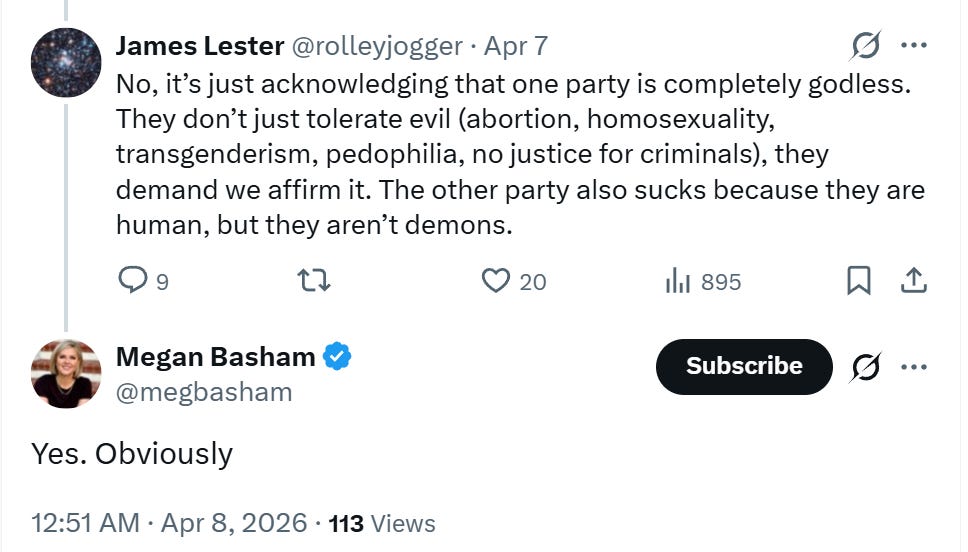
Dehumanization of political foes hinders democracy. At its worst, it has led to some of the most horrendous state-sponsored human rights abuses.
“But that conversation was just on X, which is full of attention-seeking grifters, not the real world,” you may be thinking. Fair point. Yet, I fear that the dehumanization of political foes is more widespread than that, and it’s not just on the right. An October 2024 SNF Agora/YouGov poll found almost half of the electorate believes the opposing party is “downright evil.”
What can we do? Here are a few starting points:
Pay attention to how the purist/pragmatist dilemma plays out in your own decision-making. Be respectful of those who come to different conclusions than you. Admit it’s not easy.
Build relationships with people who disagree with you. Learn to appreciate challenges to your own views.
Support efforts in your own community that help break people out of their information silos. It’s difficult to demonize people who we know personally. Events that bring people together across partisan, class, and racial divides will help reduce the perception gap.
Push back against dehumanization. Be willing to defend those outside of your partisan tribe, and criticize those within it.
Tell Your Pastor About J29!
AVC’s pastor network, J29 Coalition, is taking applications for its next J29 Cohort. Send your pastor this link and encourage them to apply.
What We’re Reading
NYT: “ICE Agents Detain Newlywed Spouse of Soldier Training to Deploy”
A U.S. Army staff sergeant and his wife arrived at his base in Louisiana last week, expecting to begin their life together as newlyweds.
The couple checked in at the visitor center, identification in hand, ready to complete the steps that would allow her to move into his home on the base.
Within hours, that plan had unraveled.
Russell Moore: “The Bible Doesn’t Justify War Crimes”
But in line with the Bible, those who wield the sword are held accountable for the use of it. And that means the language of hell is quite relevant. We can do in God’s name what he forbids only if we really do not believe that he is there, that we will stand in judgment before him. In other words, to do this evil, we must be convinced that there is no hell. When we take that bargain, we had better be right. Otherwise, there’s quite literally hell to pay.
The Roys Report: “Evangelical leaders yawn at Trump’s claim that ‘a whole civilization will die tonight’”
In response, X and other social media platforms were flooded with complaints from faith leaders ranging from liberal Protestants to the Pope Leo XIV. The latter called Trump’s threat targeting “all the people” of Iran “truly unacceptable.”
But one group refused to criticize Trump: America’s evangelical leaders, a key part of Trump’s political base. They winked at his Easter Sunday post and ignored his saber rattling.
Trevin Wax: “When the Tribe Eats the Church”
The reality is that we’re witnessing the rise of new forms of revisionist Christianity and a resurgence of fundamentalist identity simultaneously—and in both cases, the lines are as often drawn around political views as they are around theological affirmations.
Whether it’s the fundamentalist enclave devolving into an online world of ever more radical right-wing beliefs, or the progressivist mindset devolving into little more than left-wing talking points baptized in Christian rhetoric, the appeal in both cases is the sense of community. It’s the feeling of being beleaguered and outnumbered, pressing up against your compatriots in battle against the bad guys, that generates a sense of significance and purpose.
Exhausted by looking inward to discover and express who we are, we now look around desperately for the affirmation of others—the sense of identity that comes from drawing close to those who share our affinities and outlook.
