


Rhetoric from political leaders and cultural influencers can contribute to violence, but criticizing a president’s authoritarianism isn’t a call to violence.
There has been a lot of talk this week about how our words can contribute to acts of violence. An important topic, for sure, but like so much of our debates these days, the discussion is distorted through the lens of tribalism. The horror we recently witnessed should drive us to humble collective action. Instead, we seek to use tragedy for partisan advantage.
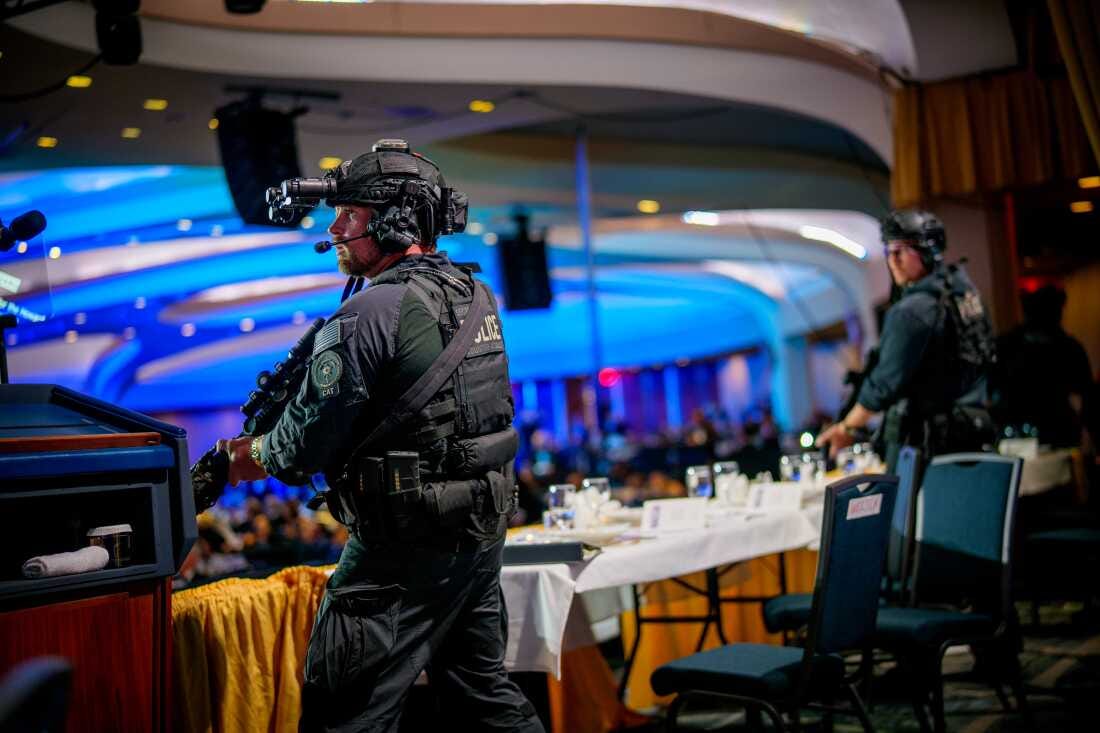
Another would-be assassin tried to take the life of our president and other administration officials on Saturday. This is now the third assassination attempt on President Donald Trump.
Here are just a few of the things that happened next.
In left-wing social media spaces, conspiracies about the assassination attempt being “staged” to boost Trump’s approval ratings immediately went viral, even though there is zero evidence. The suspect, Cole Allen, clearly had left-wing beliefs, hatred for Trump, and mental health issues.
The administration claimed those who have raised concerns about the Trump administration’s authoritarian direction are responsible. “Those who constantly falsely label and slander the president as a fascist, as a threat to democracy, and compare him to Hitler to score political points are fueling this kind of violence,” Press Secretary Karoline Leavitt claimed.
Pointing out the many ways that Trump has been and continues to be a threat to democracy is not an implicit call to violence. Indeed, in this very newsletter, we explicitly condemn political violence while also opposing the many authoritarian trends in the US today.
Speaking of authoritarian trends, Trump is once again using federal power to target a comedian for a joke he didn’t like. On Thursday of last week, Jimmy Kimmel joked that First Lady Melania Trump looked like an “expectant widow.” In a Truth Social post, Trump absurdly claimed that the joke was a “despicable call to violence.” Now the FCC is threatening to revoke the licenses for ABC’s TV stations unless it fires Kimmel. The joke was tasteless and unfunny, but it wasn’t a call to violence, and in a free society the federal government doesn’t decide what jokes we’re allowed to hear.
Also this week, James Comey, former FBI director, was indicted for threatening the president with a social media post that showed seashells on a beach arranged to form “86 47.” Given that the slang “86” for “remove” or “get rid of” is a common term in politics used by members of both parties, this is a clear case of Trump using the power to the federal government to seek vengeance on his political foes, as he promised to do during his campaign.
This isn’t the first time Trump has used the false claim that speech is violence to justify his abuse of federal power. In an October 2025 newsletter, I pointed out that Trump had directed law enforcement and the IRS to target left-wing groups for speech that opposes him.
After a previous assassination attempt on Trump, I pointed out that political violence undermines our democracy. I leave you with the same advice I offered then:
In a democracy, we resolve to settle our differences through deliberation, persuasion, and elections. Those who use political violence avoid all those norms and seek to impose their will through intimidation and harm. Democracy is hard, and change can often seem slow. Political violence can often be motivated by a desire for political expediency, but it doesn’t work. Since the Civil War, the most lasting changes have happened through nonviolence.
So what can you do, in this situation? Here are just a few suggestions:
Don’t share or repost messages that simply speculate, without evidence, on the causes or consequences of the assassination attempt.
Passions are hot right now. You may hear a friend, family member, or co-worker say something that really pisses you off. But don’t add fuel to the fire. Seek to lower, not raise, the temperature.
Be patient. Remember that much of the media is in a rush to publish as much information as it can on this event. In that rush, it’s likely to get some things wrong. Simply wait and you will learn more accurate information.
Seek justice and peace. Look for efforts in your own community where you can work to address political violence. There may be some in reaction to yesterday’s events, or programs already in place where you can make a contribution.
Some More Good Reads
Bonnie Kristian: “Quashing Political Violence Requires We Tame Our Tongues”
This is not how we think about political violence today, nor should it be. These assassination attempts are indefensible, frightening, chaotic—every bad thing. Allen tried to justify his choice in Christian terms, claiming on biblically superficial and ethically ignorant grounds that he had cause to set aside the command of Christ and instruction of Scripture. He was wrong.
Yet his self-justification did not emerge in a vacuum. With a moral imagination furnished by incoherence about political violence and a decade of constant, extravagantly pitched denunciations of Trump, he acted. In a sense, he called the bluff of everyone who speaks as if Trump (or any political figure they deplore) deserves death, despite not really believing it—the kind of fundamentally unserious people who cast, say, stealing four lemons from Whole Foods as a strike against tyranny.
Stephen Richer: “It’s Good to be the King! Using the Federal Government for Trump’s Personal Interests”
What’s different today is, first, the scope. This week it’s Trump’s face on the US passport. Previously, it was his face outside the Department of Labor. Or the Department of Justice. Or his name on the Kennedy Center. Or this week, it’s using law enforcement to punish Jimmy Kimmel. Previously, it was using the pardon power to exonerate a cryptocurrency criminal who had enriched the Trump family.
It’s also different today because Congress—the branch of government that could effectively check Trump—has zero interest in exercising any constraining authority.
Accordingly, Trump is allowed to use the federal government as he did with many other private businesses he ran throughout his life. He used those private businesses to make money, give friends jobs, and, yes, to boldly thrust his name into your face.
Now he’s doing so with the federal government.
Jonathan Chait: “Calling Trump a Tyrant Is Not a Call to Violence”
Resorting to violence merely strengthens the forces of illiberalism and sense of disorder upon which Trumpism feeds. The official Democratic Party has understood this, which is why not a single elected Democrat at any level has condoned murder attempts on the president or his allies. Allen apparently believes that if you conclude that Trump is an authoritarian, then violence against him is justified. By conflating antiauthoritarian arguments with incitement, conservatives are making the same error but following it to the opposite conclusion.
The norm that many Trump-supporting conservatives seek to enforce is not a prohibition on violent rhetoric or even limits on attacking politicians who are seen as threats to democracy, but a one-sided ban imposed on Trump’s critics so that the president can do as he wishes. Defining political violence as something that is being wielded primarily or exclusively against Trump is to condone his behavior.
The Dispatch: “A State Church Isn’t a Panacea for Cultural Problems”
There are myriad theological and evangelistic reasons for favoring nonestablishment as a framework for church-state relations. But I want to focus on the sociological and cultural reasons for opposing establishment, using the United States as a case study of sorts for why nonestablishment offers a superior environment for the flourishing of true religion, houses of worship, and the spiritual lives of its people. Far from being a benefit solely for secular or nonreligious Americans, nonestablishment improves the conditions for all of us.
