


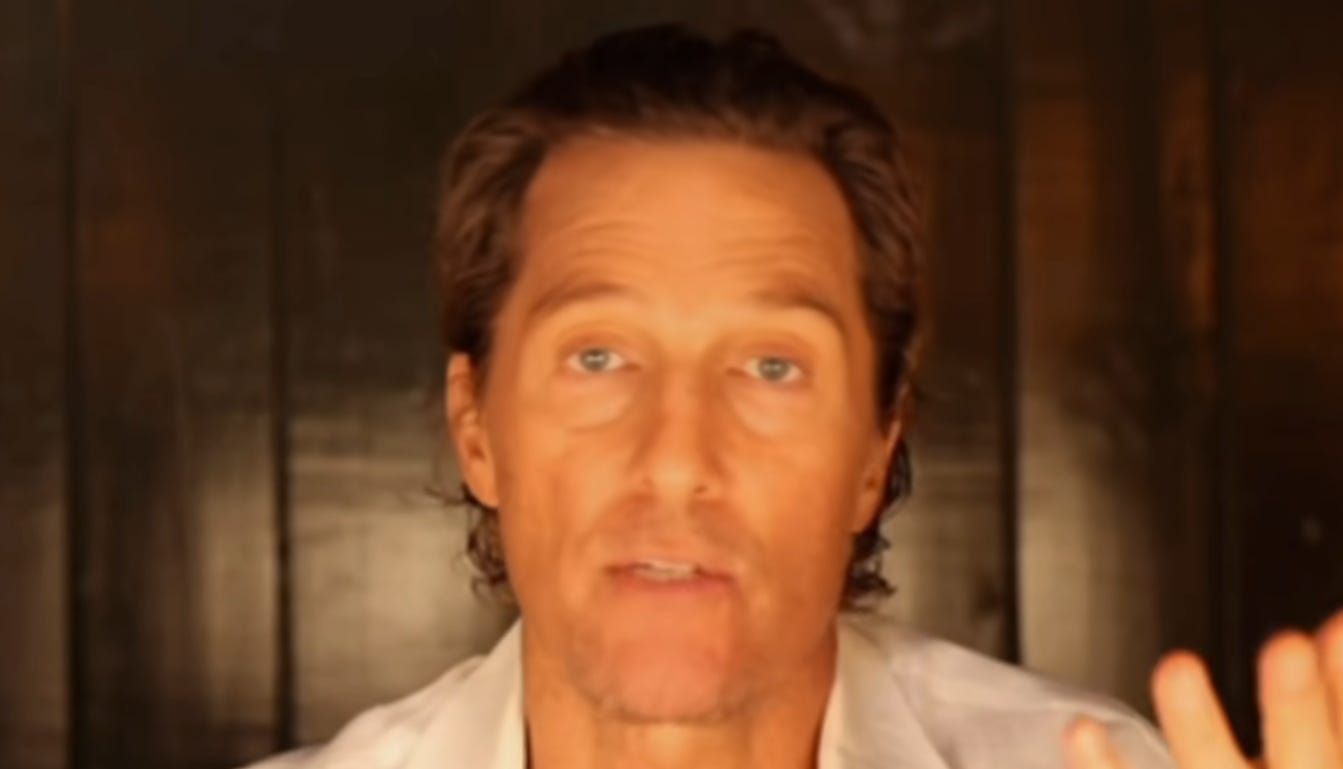
Actor Matthew McConaughey encouraged voters to consider independent candidates. His argument is a confusing mess, but he gets some things right.
If you want to watch the six-minute video before reading my reaction, you can do so here:
McConaughey says he’s not here “to endorse a candidate or a party,” but rather “fairness and reality.” Given that there are more independents than either Republicans or Democrats, he suggests the election is unfair because independent candidates aren’t treated “as a real and potential winner on the ballot and considered seriously by us.”
He then describes his view of independent voters:
“Independent does not mean you’re middle of the road. Independent is the original road. Before there was ever a Republican or a Democrat, there was an American. Our birth certificate is not the Declaration of Compromise, it is the Declaration of Independence. And a true independent is not a fence-sitter, Mr./Mrs. ‘In-Between,’ ‘I don’t know how I feel.’ No. A true independent is not even against the Rs or the D’s; a true independent takes the best of both. And that’s not indecision, it’s judgment.”
I agree that a responsible voter should consider all the candidates, including independent candidates. But McConaughey talks about independent candidates as the rightful leaders of independent voters. This is wrong in several ways.
“Independent” isn’t the same as a political party. Independent voters don’t gather at a national convention to decide what policies they support. Independent voters don’t all want the same thing. They’re all over the map. The same is true with independent candidates, who may represent the views of some independent voters, but it would be impossible to represent them all. Voters can be independent for many reasons. Some may be as McConaughey describes, but others hold extremist views, on the right or the left.
Many independent voters are partisan in their voting habits, consistently voting either Republican or Democrat. McConaughey acknowledges this, while calling those of us who point out this simple truth “skeptics.” These independent-leaners are often more consistent in their voting than weak partisan identifiers.
The “true independents,” those who neither identify with a party nor vote consistently for one, are nothing like McConaughey describes. These voters are mostly apolitical. They don’t know much about politics or the candidates. They don’t vote at a high rate. They just don’t care much about politics.
McConaughey gets even more confusing next when he talks about what he expects these independent voters to accomplish.
“In most races, the parties are the only real choice on the ballot, and the few [independents] we have sent to Washington have always had to pick a door—an R door or a D door. Now, that’s two doors, but no third. ... In a Congress as close as this one, three to five true independents—ones who don’t caucus with either side—well, they’re not a minority, they’re the majority maker. Nothing passes without them; every bill has to come through the middle, which means both parties would finally have to compete for the middle. Most of us think of it like football: the two parties want to play the whole game in their own end zones, right? Well, independents keep the game between the 40s where most of America actually lives. Independents don’t just have leverage, they actually are the leverage.”
Wait a second, McConaughey had just finished telling us that “independent does not mean you’re middle of the road,” but now he says they are the middle, using a football field analogy this time. So which is it? Independent candidates can be to the right of Republicans or the left of Democrats. Again, being independent doesn’t necessarily make one a centrist.
Also, he criticizes independents who do win office for caucusing with a party. In the US Senate, for instance, Bernie Sanders and Angus King are independents who caucus with the Democrats. On this point, McConaughey demonstrates a common misunderstanding of how democracies work. In order to govern, all democracies must form a majority coalition. In multiparty systems, the majority coalition is formed after the election. Usually, the party with a plurality will make offers to one or more minor parties to get to a governing majority. In a two-party system like ours (which is a function of our winner-take-all elections), the governing majority is formed before the election in the form of a big tent party comprised of many diverse coalitions.
There is a nugget of truth to the scenario McConaughey describes, however. In a closely divided House or Senate, a group of three to five independents could decide which party wins control, and extract some concessions for doing so. But in order to do that, they would have to agree to caucus with either the Republicans or Democrats, exactly the move that McConaughey criticizes. McConaughey also assumes all the independents are in lockstep, which isn’t a safe assumption.
Despite all the errors, I think McConaughey’s main point is correct. Voters shouldn’t eliminate independent candidates from consideration simply because they have little chance of winning. (Of course, if more voters took this advice, they might have a chance of winning.) The belief that you must only consider candidates who have a chance to win is one of the reasons we elect so many bad politicians. When general-election voters think this way, primary voters don’t have to worry about electability. They can select the most far-left (for Democrats) or most far-right (for Republicans) candidates because they know most voters will fall in line behind one of the two choices on general election day. If independent candidates start getting lots of votes, they can change this calculus even if they don’t win an election.
So on this point, McConaughey is correct: voting independent is not a wasted vote.
Recommendations
Phil Williams: “Hymns, Hate, and ‘Holy Wars’: What I Saw Inside a Christian Nationalist Conference”
As I sat through the conference, it appeared Wilson and his allies may now sense the most belligerent forces are ascendant and that they fear losing control of the movement they created.
Which is why that infighting became a key focus of the “Holy Wars” event.
“There are people that communicate online in ways that they would never dream of communicating in person,” Wilson said in the conference’s opening address on Friday morning, delivered in his traditionally grandfatherly way.
“In order to talk to someone in the flesh the way that people talk online, you would have to have at least three drinks.”
Thomas Edsall: “‘Polarization Is the Price U.S. Society Has Had to Pay for Real Progress’”
With President Trump in the White House, rising authoritarianism has prompted a battle royal within academia over polarization, pitting those who argue that it undermines democracy against those who see it as a tool to motivate defenders of democracy.
Bonnie Kristian: “Why I left Christianity Today”
As I told Graham, and she partially quoted: Christianity Today has an increasingly muddled sense of its place within American evangelicalism and a C-suite that exhibits discomfort with, disinterest in, and sometimes even distaste for journalists and our work. And the intersection of that uncertainty and that discomfort, in my view, is leadership increasingly driven by fear, by the kind of anxiety about reputational and financial loss that makes bold, interesting, principled journalism very difficult.