


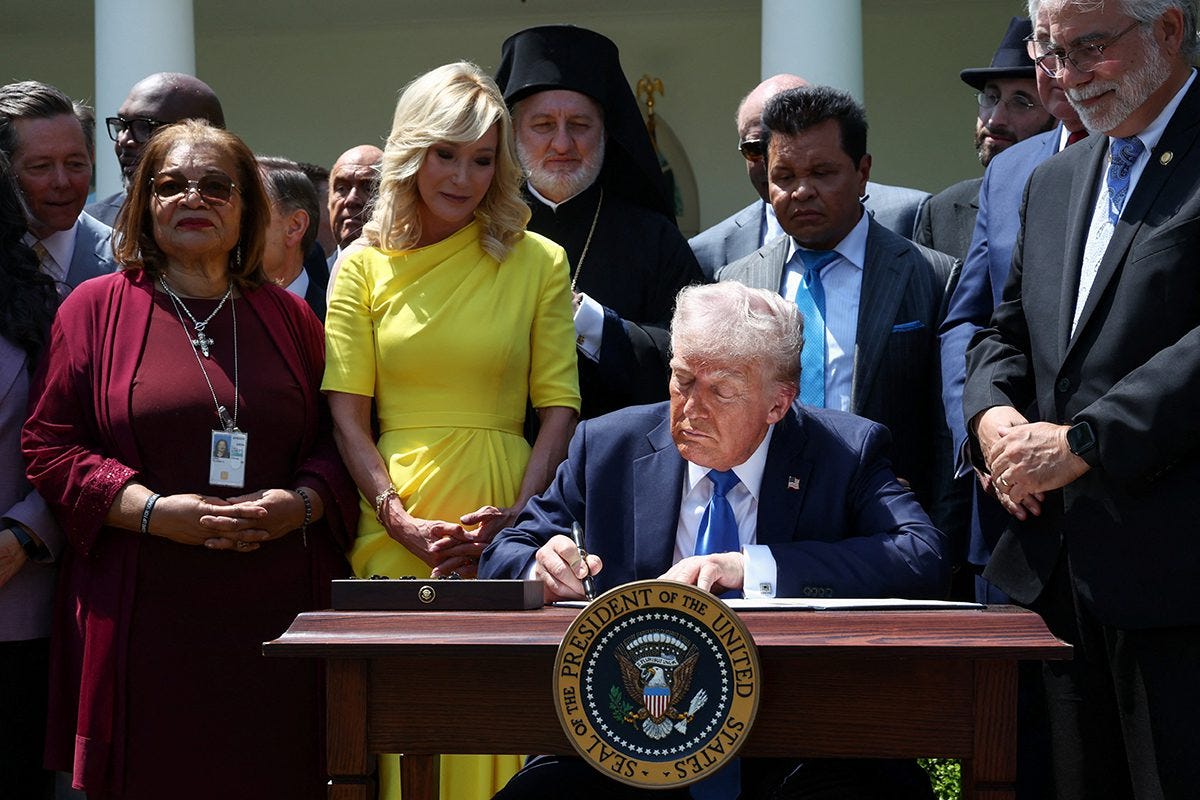
The Religious Liberty Commission’s draft report turned out better than expected.
The Religious Liberty Commission was created by President Donald Trump last year to make religious liberty policy recommendations. The draft report, created after seven public hearings, was published two weeks ago. After a comment period, which ends on Monday, a final draft will be published. The Commission can only make recommendations, so nothing in the report automatically has the force of law.
The Commission and its advisory boards are not religiously or ideologically diverse. The membership is mostly Christian with a substantial Jewish presence. Other than those two faiths, only one Muslim appears on an advisory board. (This lack of diversity is the subject of a lawsuit, Interfaith Alliance v. Trump.) Plus, no commission members or advisors identify as politically liberal or progressive (though some members would be considered liberal on certain issues, such as Catholics and the death penalty).
The report reflects this lack of diversity. The examples in the report lean heavily toward discrimination against Christians and Jews. Latter-day Saints only appear once, in a footnote, which is odd given their importance in religious freedom court cases and their general support for Republicans. Non-religious people are only mentioned for comparison and to note the benefits they receive living in a nation with religious freedom. There is one reference to religious liberty protecting “believers and nonbelievers alike,” but beyond that, there is no elaboration on the rights of nonbelievers. On the plus side, the report does provide examples of religious discrimination against Muslims, Hindus, and Sikhs.
The report is correct to note that “separation of church and state” has been misinterpreted by some to mean government favoritism of secular over sectarian groups. The neutrality principle, that government shouldn’t favor certain religious groups or non-religion over religion generally, best reflects the Founders’ intent. It also has the benefit of enabling the most religious freedom for all and is consistent with where the U.S. Supreme Court has been, more or less, for at least the last couple of decades.
But I take issue with the report’s reframing of church/state separation, which is a key theme of the report. It is true, as the report points out, that the phrase “wall of separation between church and state” does not appear in the Constitution, but the concept is certainly implied by the establishment clause “Congress shall make no law respecting an establishment of religion ...” and free exercise clause “or prohibiting the free exercise thereof, ...” of the First Amendment. Our Founders understood the dangers of religious establishment, both for the government and for religion, and wanted each to play its proper role. They were well aware of the dangers of mixing religious authority with state power.
On the plus side, “America’s peaceful religious pluralism” is mentioned in the EO creating the Commission, and pluralism is praised throughout the report. Oddly, however, the report suggests secularism stands in opposition to pluralism. “Though not a religion, secularism, like theocracy, is incompatible with our First Amendment freedoms because it excludes religious voices from the process of self-government,” the report states. A truly pluralistic society would be inclusive of secularism, not in opposition to it. Pluralism means everyone is free to live according to their beliefs. You can reject religious beliefs, even be hostile to them, and your beliefs are still protected.
Nonetheless, the most useful parts of the report, given today’s political environment, are its defense of pluralism, rejection of antisemitism, and condemnation of theocracy. As regular readers of this newsletter are aware, there are growing movements on the right that reject all three of these. So here is my suggestion: use the good parts of this report in your conversations with friends and family members caught up in right-wing extremism. Quoting sources like MSNBC or the New York Times will likely be rejected right away, but if you quote the Trump administration itself, you can gain a sympathetic ear.
Tell Your Pastor About J29!
J29 Cohort equips pastors and ministry leaders to cultivate a Jesus-shaped political imagination in their congregations. Through high-quality training from experienced leaders and shared learning alongside fellow clergy from across the country, participants will be formed for faithful, thoughtful engagement in their local contexts.

Send your pastor this link and encourage them to apply.
You can also help pastors participate in this program by giving a tax-deductible contribution today.
What We’re Reading
Caleb Campbell: “Anxiety About Affiliation: Why many pastors are becoming cautious about who they are seen with and what the Church loses because of it.”
Many leaders have grown cautious about relationships outside their theological, political, or cultural tribe because association is often treated as endorsement. Which tribe are you aligned with? What leaders are you platforming? Whose side are you on? These questions increasingly shape pastor’s relational networks.
When I started in ministry in the late 2000s, the atmosphere felt different. Across many parts of the American Church, there seemed to be genuine energy toward widening the tent. Pastors were building friendships across traditions and secondary theological differences. Conversations about racial reconciliation, immigration, justice, and sexuality were often difficult, but many leaders entered them with curiosity and hope.
There seemed to be a growing desire to embody the unity Jesus prayed for.
The Bulwark: “Why We Won’t Stay Silent About Christian Nationalists in Our Own Churches”
The latest real-world skirmish over the ever-amorphous Christian nationalism erupted this June at a conference in Ogden, Utah, titled “The War for Normal” and organized by fledgling religious publisher New Christendom Press.
The world quickly learned from various posts on X what exactly passes for “normal” in these circles when a self-described Nazi employee of Antelope Hill, a small publishing house infamous as the preeminent North American publisher of fascist texts, was caught hawking pro-Hitler materials, including books published by the Nazi Party’s paramilitary Schutzstaffel, better known as the SS.
Blake Callens, a writer and early public critic of Christian nationalism, has noted that “one can consider authoritarian Christian Nationalism to be fringe enough that it will never gain traction within the broader American system while being keenly aware that it is a growing movement within the conservative church.”
As Christians, we find that Callens’s warning speaks to us directly. One of the presenters at the conference, Zachary Garris, is a minister in our denomination, the Presbyterian Church in America, and we feel a pressing duty to speak out about this malignant ideology. Because if the Nazi materials on the Antelope Hill table can teach us anything about history, it’s the danger of what a fringe movement can do if reasonable people remain silent.
The Carolina Journal: “Civil discourse and the art of disagreement”
Civil discourse and respectful disagreement are essential to a free and thriving society. The ability to say “I disagree” defines individuality, protects liberty, and drives progress. Throughout history, leaders such as Thomas Jefferson, Nelson Mandela, Martin Luther King Jr., and Winston Churchill shaped history through principled disagreement.
Today, however, disagreement has become increasingly hostile. Public debates over race, immigration, gender, healthcare, and politics are often marked by shouting, insults, and division rather than thoughtful conversation. We no longer disagree; we demonize. As Proverbs 18:2 reminds us, “Fools find no pleasure in understanding but delight in airing their own opinions.”
Åbo Akademi University: “Democratic innovations are challenging to implement – but when successful, they strengthen democracy”
Democratic innovations include, for example, deliberative citizens’ panels, participatory budgeting, and digital platforms for citizen dialogue—that is, tools and methods that allow “ordinary” citizens to express their views on societal issues and influence decision-making more actively. Democratic innovations engage people between elections.
…
Fishkin sees two possible paths forward: either creating many smaller citizens’ panels or developing structures that allow many or all citizens to participate. The latter could include digital platforms for public discussion, institutions that spread deliberation more widely throughout society, or initiatives such as Deliberation Day, a kind of national holiday before an election, when citizens are given the opportunity to gather and deliberate.
Brookings: “That they may thrive: Reimagining purpose, agency, and breadth of skills in education through cross-country collaborative research”
The erosion of democracy, political polarization, and increased conflict require education systems to reimagine the purpose of education and provide students with agency and a breadth of skills for a democratic future.
A generation of children is growing up amid heightened political polarization, and in many contexts, under prolonged forms of authoritarian leadership. In contexts with access to digital technology, these conditions have been reinforced by algorithmic bubbles on digital platforms that promote rigid worldviews, distrust of pluralism, and narrow understandings of identity, power, and belonging.
…
Current education systems often position students as passive recipients of knowledge, while few create learning environments where young people can question, explore, deliberate, and connect what they learn to the realities of their lives. Preparing young people for democratic futures requires learning that develops agency, critical thinking, ethical reasoning, dialogue, collaboration, and the ability to engage with complex ideas. These capacities help students interrogate claims, weigh evidence, recognize multiple perspectives, and participate meaningfully in shaping more just and inclusive societies.