


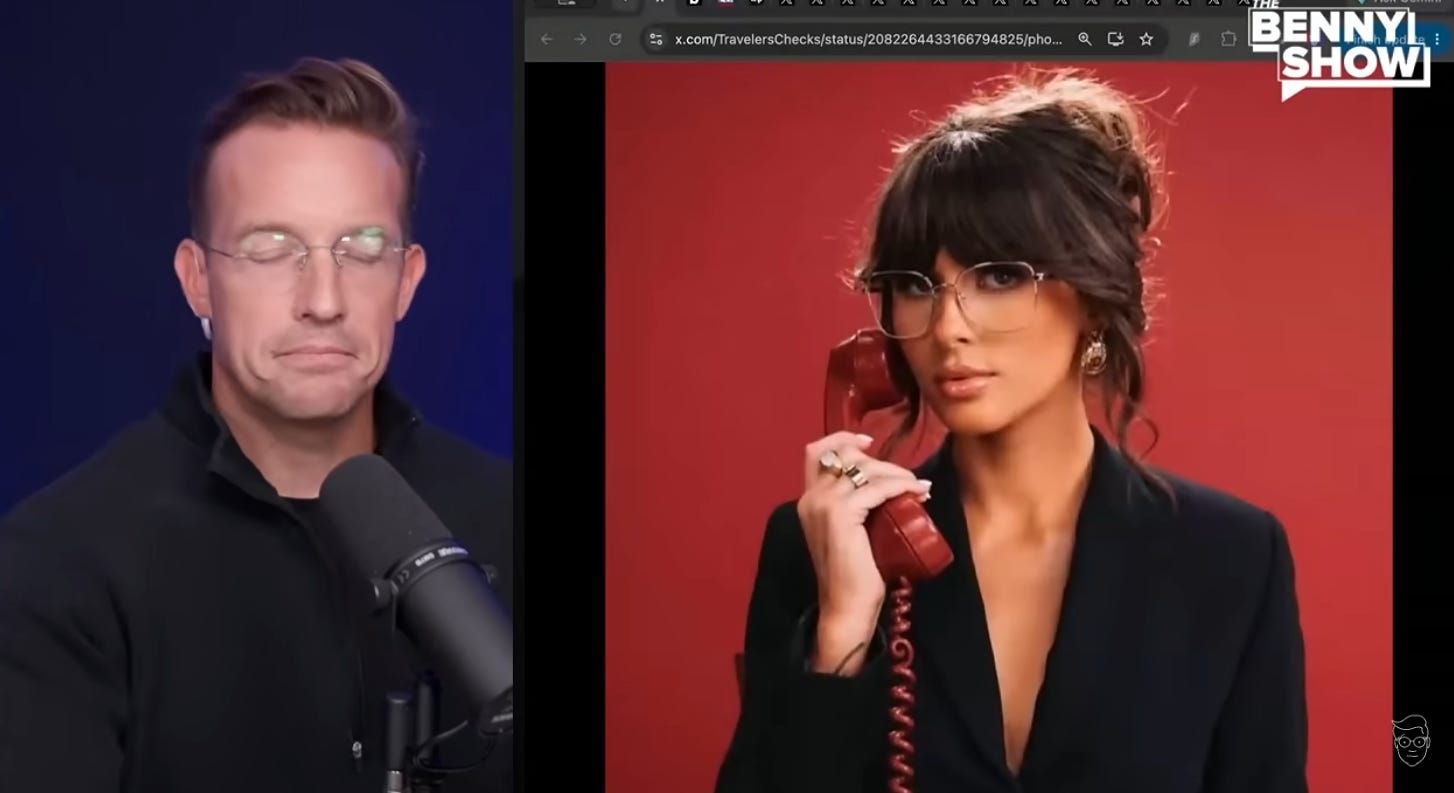
When right-wing influencers talk about “American culture,” they’re not talking about all Americans.
“American Culture is winning,” Benny Johnson announced last week. The reason? A country song is #1 on the pop charts.
I share this with you not because his argument is unusual. It isn’t. I’m sharing it because it’s such a clean example of how these influencers use misinformation, manufactured outrage, and tribalism to drive fear and division.
If you want to listen to the full 9 minute, 29 second monologue before proceeding, you can do so here.
First, here’s some context. Ella Langley’s “Choosin’ Texas” has been the #1 song on the Billboard Hot 100 for 16 non-consecutive weeks, which broke the record on August 3 for the longest run by a solo female artist, previously held by the 14-week records of Whitney Houston’s “I Will Always Love You” and Mariah Carey’s “We Belong Together.” And it’s breaking other records as well, such as the first song by a woman to ever top the Hot 100, Hot Country Songs, and Country Airplay charts simultaneously. It’s a huge hit. You can watch the official video on YouTube here.
There is nothing in the song or video that is political. Johnson is using the song’s success, and rap music’s current dry spell1, to build his own mythical culture war narrative. According to this myth, country music represents the real America and rap music is anti-America, the success of the song represents the resurgence of conservative values, and liberals are angry at the success of the song.
“Mariah Carey and Whitney Houston dethroned, and libtards are in shambles over this,” Johnson declared.
Johnson doesn’t cite any liberals who actually complained about the song and I couldn’t find any with a Google search. Indeed, for a song to be this successful, it would have to be popular with a broad swath of the public, not just those on the right.
MAGA’s new punching bag, USAID, also comes into the picture. Johnson claims that rap music is not doing well on the pop charts today due to USAID getting defunded.
“USAID gets defunded, and non-gay country music starts dominating the charts,” Johnson said, quoting a post on X.
Rap music wasn’t funded by USAID. That’s absurd. This is one of the newest conspiracies being spread among right-wing influencers. Two unrelated events formed the foundation of this conspiracy. In 2014, an Associated Press investigation found that USAID contractors had tried to infiltrate Cuba’s hip-hop scene to spread anti-communist messages. And in February 2025 there was a controversy about a Palestinian non-profit that received USAID funding but who’s executive director was a rapper who rapped anti-Israel lyrics. Contrary to Johnson’s claim, the USAID funding didn’t fund his music, it funded a program training female entrepreneurs. In Johnson’s fever dream retelling, his “culture” was under attack by dark forces in the government, and this included an attack on country music.
“We were suppressed,” Johnson said, “and our culture was manipulated and scoped by our own tax dollars and intel agencies.”
Country music and rap/hip-hop both originated in America. They’re both part of American culture. But in Johnson’s formulation, country represents the true America while rap/hip-hop do not. He refers to rap as “mumble rap” and “hedonistic garbage.”
Johnson also has something to say about race, associating “real America” with country music and whiteness. By contrast, rap is anti-American and black. He’s not subtle about it. He describes Langley as a “beautiful white woman” and claims liberals dislike her because, quoting another X account, “they hate whites, they hate beauty, they hate everything wholesome; they especially hate America because it is all of those things.”
Johnson implies he’s a recent convert to country music and it shows.2 While it’s true that rap has a strong following among black people and country fans skew white, there are white artists who have found success in rap (Eminem, the Beastie Boys), and there are black artists who have found success in country (Charley Pride, Darius Rucker, Kane Brown). In fact, the two country songs that hold the record for the longest run at #1 (19 weeks) are held by black artists — Shaboozey’s “A Bar Song (Tipsy)” and Lil Nas X’s “Old Town Road.” Additionally, the roots of country music owe much to Southern black blues and banjo styles.
Country music success comes in waves. In the 70’s, we saw the success of Outlaw Country, followed by the hugely popular John Travolta film “Urban Cowboy” in 1980. After a lull, country became popular again with the legendary “Class of ‘89,” led by the mega-stardom of Garth Brooks. After another dry period in the 2000s, country is again seeing the next successful wave. But this new wave is quite the opposite of what Johnson describes.
Rather than distinguishing itself from hip-hop, today’s country embraces it and combines these distinctively American styles of music. It’s hard to miss if you spend a little time listening to a modern country radio station. For the uninitiated, I invite you to check out the music of Kane Brown or Jelly Roll to start. And it’s not just the influence of hip-hop on country artists having an impact. Artists from hip-hop, pop, and R&B have themselves successfully crossed over into country. Witness Post Malone and Beyoncé, whose album Cowboy Carter was created to reclaim the black roots of country.
The current wave of success for country music does show that American culture is winning, but not in the way Johnson thinks. It’s successful because it blends America’s diverse cultures, and in doing that it reflects one of America’s greatest strengths — pluralism.
More Good Reads
More In Common: “Making Sense with More in Common: Trump Voters’ Support for the Iran War Continues to Drop”
Support for the war in Iran has dropped among all segments of Trump voters since April. Less than half of Mainline Republicans and the Reluctant Right support the war, while even among MAGA Hardliners support has fallen 8 points.
WSJ: “How ICE Is Weaponizing Social Media Against Its Critics”
Tired_Thumb is far from alone.
In recent months, ICE has deployed a round-the-clock digital dragnet to scour the public internet—from Facebook to Instagram to X—for speech that could endanger the agency’s mission. The government has paid millions to private contractors to surface everything from potential threats to agents to activities that could disrupt ICE’s operations, according to federal documents, contractors and former Homeland Security Investigations agents.
The program has ensnared U.S. citizens and activist groups that alert community members about ICE activity. Contractors prepare daily reports and dossiers on threat actors, identifying the poster’s name, location, date of birth, workplace, Social Security number, vehicle registration and criminal history when possible.
AS: “Umberto Eco, writer: ‘The tragedy of the Internet is that it has promoted the village idiot to the level of bearer of truth’”
Umberto Eco stands among the most influential European writers, thinkers, and philosophers of the 20th century. His work spans groundbreaking essays on semiotics, beauty, language, and philosophy, as well as celebrated novels like The Name of the Rose, Foucault’s Pendulum, Baudolino, and The Prague Cemetery.
But Eco was also known for speaking his mind—fearlessly and often provocatively—on just about any topic, including the rise of social media and its impact on modern life.
Even though he passed away in 2016 at age 84, Eco left behind sharp reflections that feel even more relevant in today’s hyper‑connected world. One of his most quoted lines captures his skepticism perfectly:“The tragedy of the Internet is that it has elevated the village idiot to the status of a bearer of truth.”
Rap music falling out of the Billboard Hot 100 is partly due to recent Billboard rule changes.
In fact, I wonder if Johnson even paid attention to Langley’s lyrics since he claimed the song is about “loving Texas.” That is not what the song is about.
