


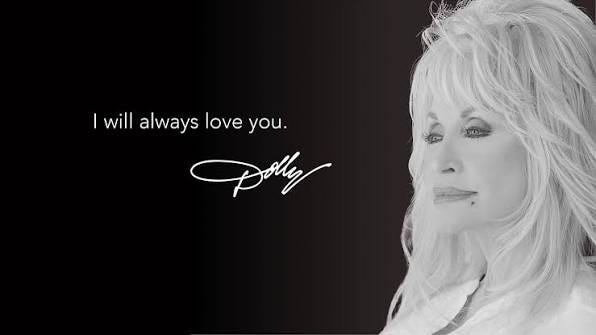
Our nation mourns the death of Dolly Parton, a national treasure known as much for her gracious spirit and humanitarianism as her musicianship.
In November 2023, this newsletter wrote about what may have been her most political song, “World On Fire,” from her Rockstar album. In an NPR interview, she said the song was “not political,” by which I assume she meant not partisan. The song was more about the relationships broken over politics, she explained, “the great divide, I guess, is more what I’m talking about, and what it’s even doing to families, even my own.”
You can read that newsletter here:
Dolly Parton's New Rock Song Is About Political Division

Dolly Parton tackles the topic of political division in her new rock song "World on Fire."
Despite her claim that she doesn’t “do politics,” this wouldn’t be the first time Parton had something to say about our national politics. When she was touring for her film “The Best Little Whorehouse in Texas,” in 1982 she told an interviewer that she “kinda wanted to make a statement with this picture.”
“It points a finger at a lot of people, and some of ’em ain’t whores. Like people who get fake religion. It’s a shame the title sounds so risqué because certain people in the Moral Majority who should see it may be turned off,” she said. “There are many wonderful people in this world, but there are many more people who just think they’re wonderful,” she continued. “In fact, they are self-righteous hypocrites, sinners because they commit crimes like judging thy neighbor. The truly religious forgive.”
Wise words from a wonderful woman.
Measles Are Back
The measles outbreak in Lancaster County, Pennsylvania, has now led to two deaths. As of Tuesday, there have been 393 confirmed cases and 70 hospitalizations in Pennsylvania alone. According to the CDC, as of August 20, there have been 2,777 confirmed cases in 45 states plus two other jurisdictions nationwide, which has already surpassed the 2025 total of 2,289 confirmed cases. The real numbers in Lancaster County are likely much higher due to the Amish population, which has less engagement with the formal healthcare system.
Vaccine misinformation leading to suffering and death was predictable and predicted. If someone has a sincere ethical or religious objection to taking a vaccine based upon true information, we should respect that. If schools or employers want to require vaccines for their employees or students, we should respect that as well. But by and large, what is happening today is due to people being misled by leaders making untrue claims about vaccines.
In 2021, Robert Kennedy Jr., our current secretary of Health and Human Services, gave a speech in Lancaster County claiming that vaccines cause autism. The 1998 paper making that claim has been retracted and since then several large-scale studies have all come to the same conclusion — there is no relationship between vaccines and autism. The 2002 Danish cohort study published in The New England Journal of Medicine had a sample of 537,303 children. A follow-up to that study tracked 657,461 children over a decade. A 2015 study published in the Journal of American Medical Association looked at 95,000 children. And a 2014 global meta-analysis looked at combined data of over 1.25 million children. The retracted study that led to the myth had a sample of 12 children.
We don’t know if there is a direct connection between Kennedy’s speech and the two deaths. There are certainly many paths to vaccine misinformation. Thankfully, in April 2025, Kennedy called the measles vaccine “the most effective way to prevent the spread of measles.” But it doesn’t help that our own HHS secretary and president have at other times sown doubt about the effectiveness of vaccines.
In Other News
Bonnie Kristian: “Texas Should Not Define Religion Down”
As my former colleague at The Week Joel Mathis writes of the proposal to restrict Texas Muslims’ worship by fiddling with the definition of religion, it’s easy to imagine a scenario where that redefinition would come back to bite conservative Christians who now support it.
“Islam itself is not just a religion,” Schoolcraft told the Times. “It’s much more than a religion.” But as Mathis observes, Christians talk this way about our own faith. I heard countless times in youth group that “Christianity is not a religion; it’s a relationship.” And many of our own religious liberty arguments—arguments I support, to be wholly clear—rest on the point that Christianity is not and cannot be confined to what we do inside the sanctuary on Sunday morning. Our faith makes claims on the whole of our lives (Rom. 12:1–2).
The argument Schoolcraft is making is in this sense deeply secular: He’s joining other voices in our increasingly religiously ignorant society in speaking about faith as if it’s a hobby, something to be set aside when it conflicts with public goods and squeezed out of sight when it makes other people uncomfortable.
Yet if Texas were to define religion down because of Christians’ discomfort with Muslims, what’s to prevent that same redefinition squeezing Christians in the future?
NYT: “In Building His Border Wall, Trump May Bring Down a 110-Year-Old Church”
Local volunteers have begun restoring the church, El Corazón Sagrado de la Iglesia de Jesús. They view it as one of the last vestiges of a shared history along a southwestern landscape that is as Indigenous, Spanish and Mexican as it is American. Fortifying its walls and twin towers means that perhaps the bell could ring again.
Now their work faces a new danger: President Trump’s border wall. The church is one of dozens of historical sites across the Southwest threatened by the construction. In Arizona, portions of a 1,000-year-old etching in the earth have been bulldozed. In Texas, work is endangering ancient cave murals and landmarks on the Underground Railroad.
“If you value a people’s worth and contributions, then you preserve their history in textbooks and curriculums,” the historian Trinidad Gonzales said. “You would preserve these physical markers.”
Trump administration officials say the wall will go up yards away from the church and help deter violent drug traffickers in one of the most remote parts of the Chihuahuan desert. Preservationists, though, warn that the relentless vibrations of the construction threaten the church’s fragile structural integrity.